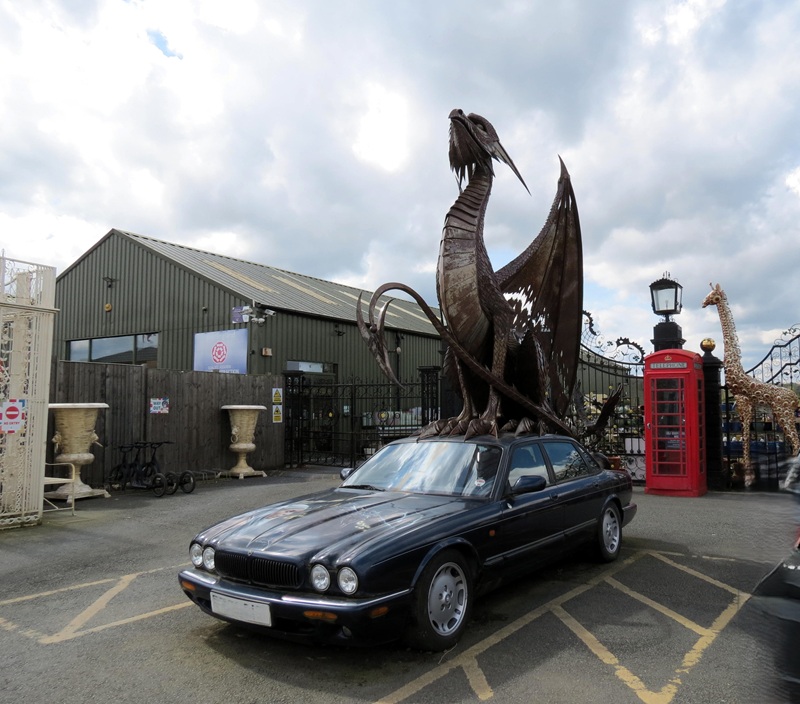
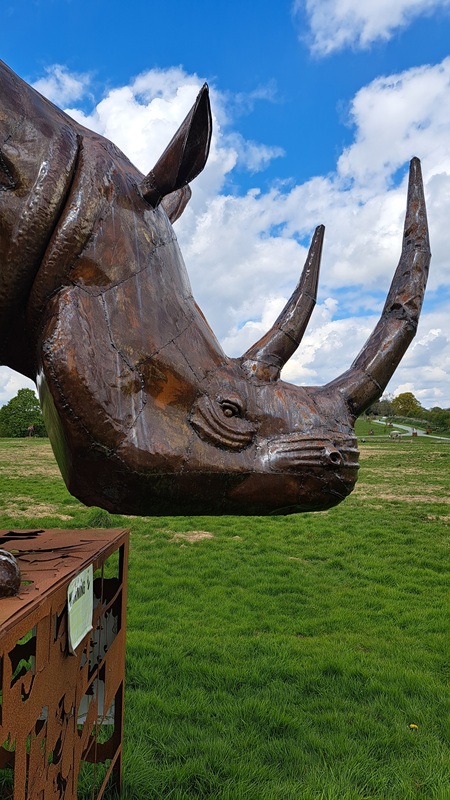
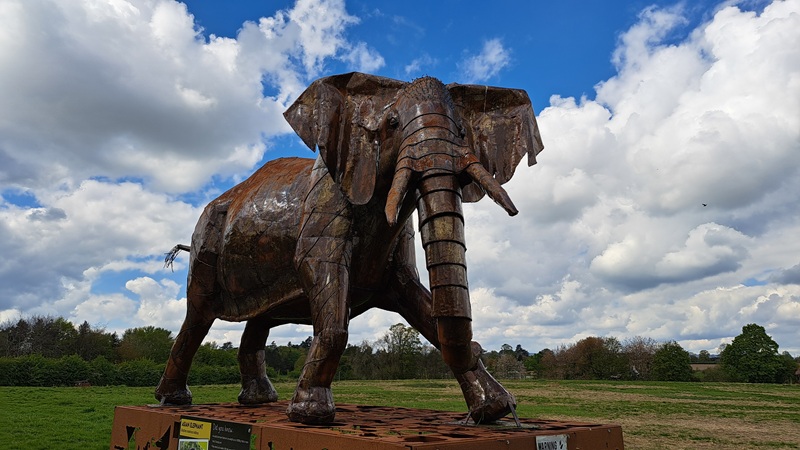
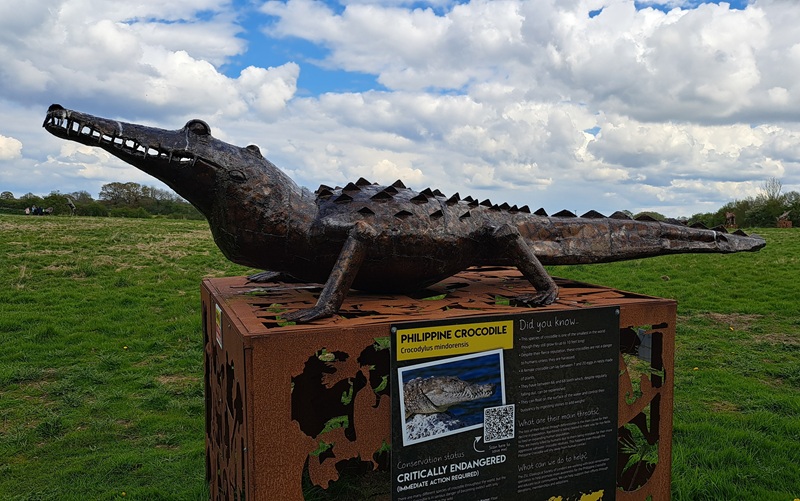
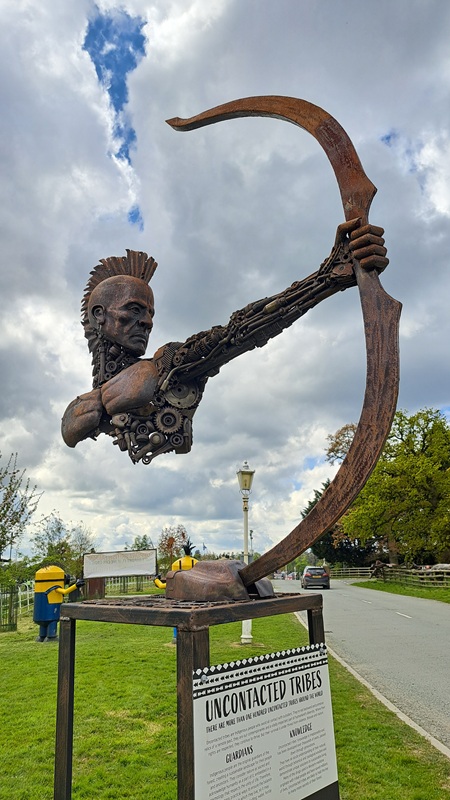
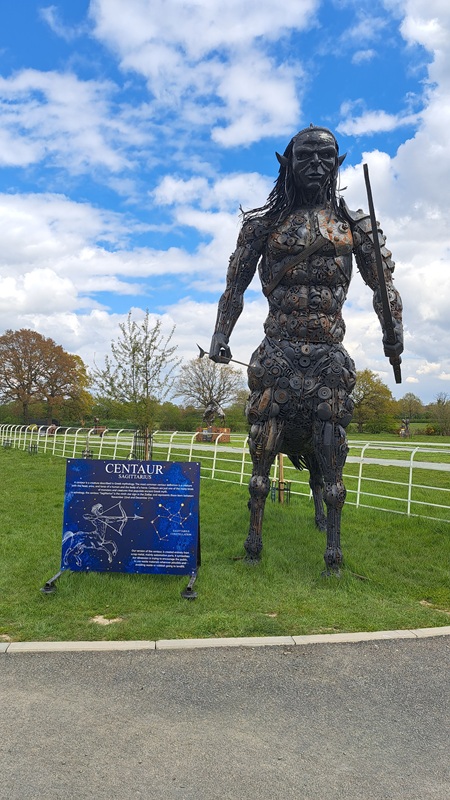
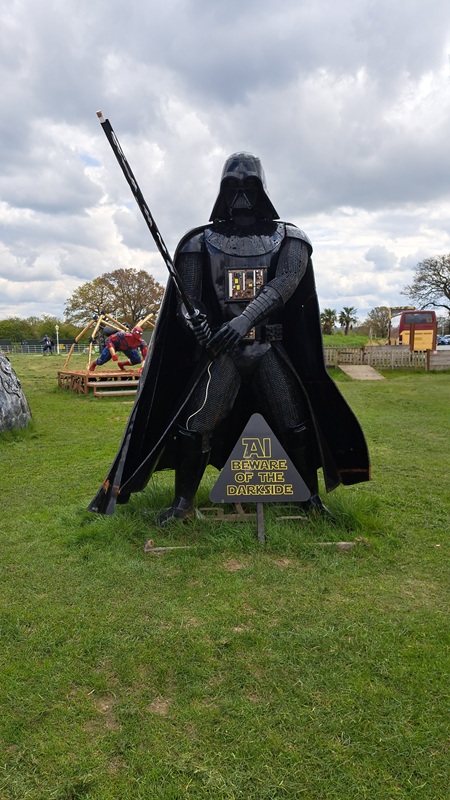
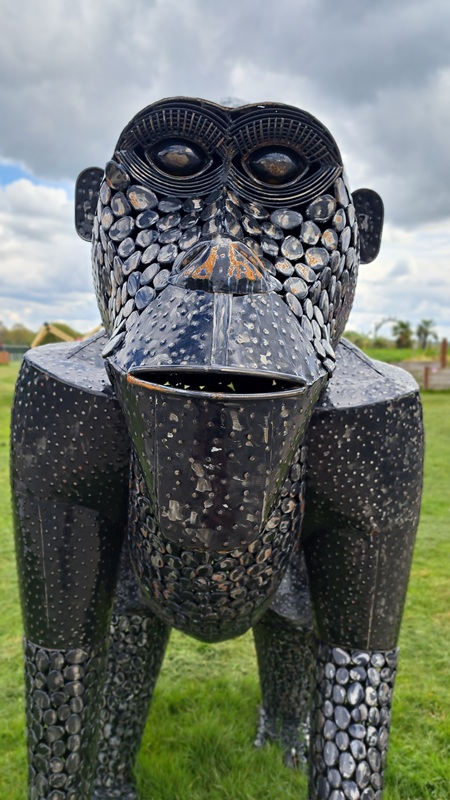
A couple of years ago, my friend and I visited the British Ironworks Centre in Oswestry, Shropshire. The centre says:
Each sculpture has its own unique message and aims to educate our visitors on global issues and spread our motto:
Art With Conscience
It’s a cool motto I think and such a great way to get the message across.
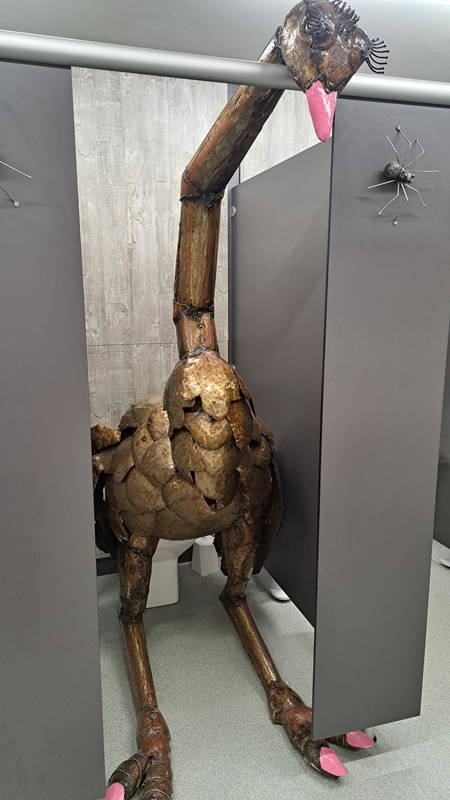
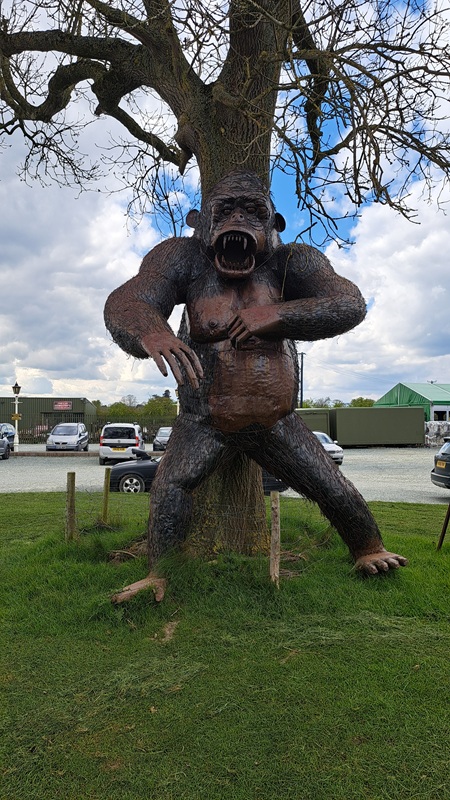
It’s a great place to visit – there’s lots to see and do from a sculpture park and grounds to explore to shopping and creative workshops. The first thing I explored was the ladies toilets where I met this fellow taking up one of the cubicles – could have shut the door!
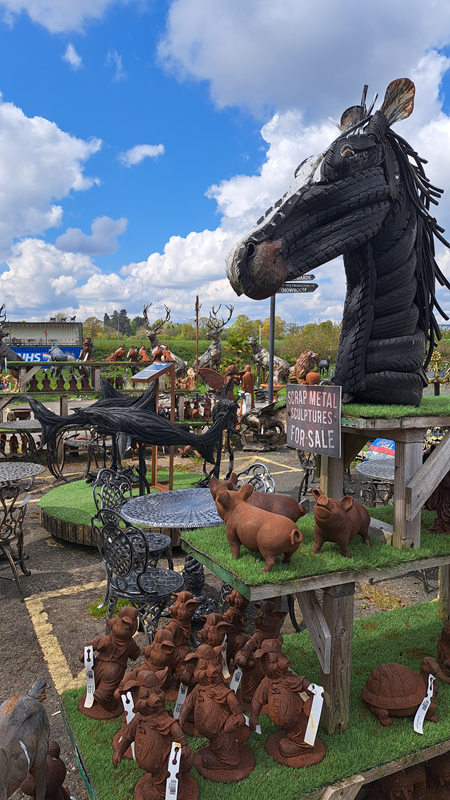
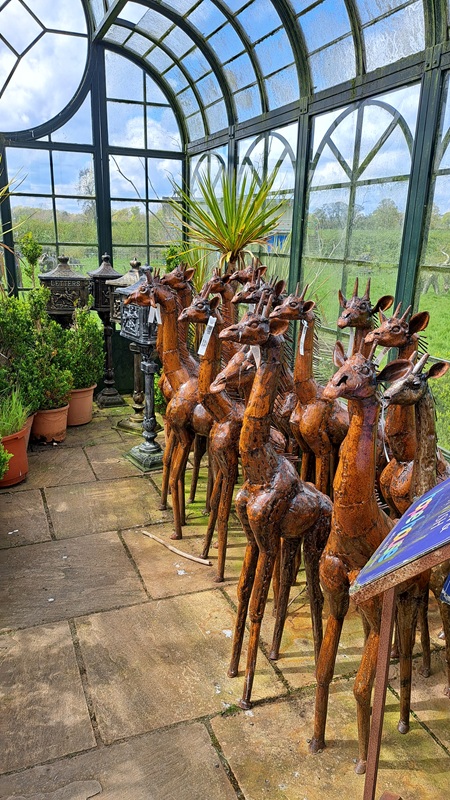
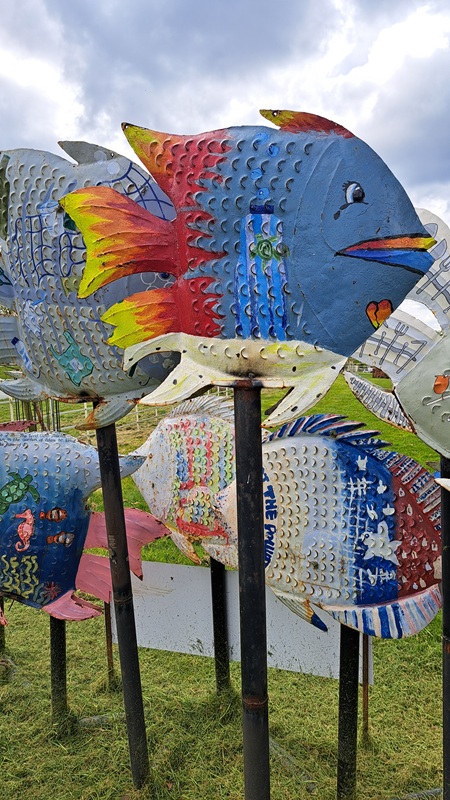
There is a garden full of scrap metal sculptures you can buy.
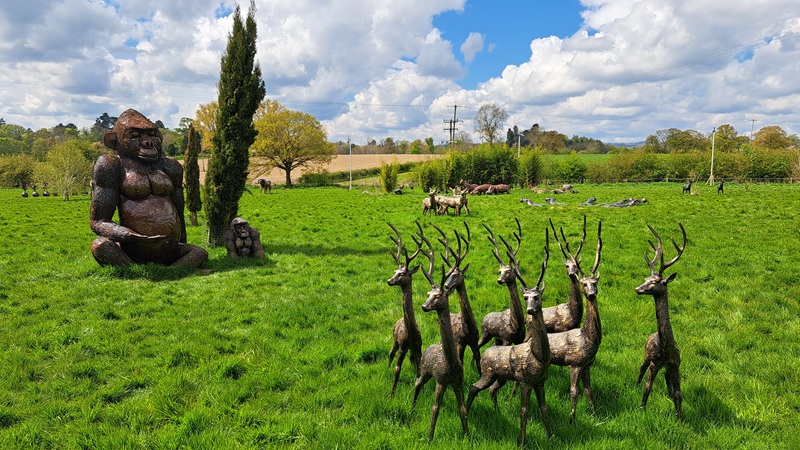
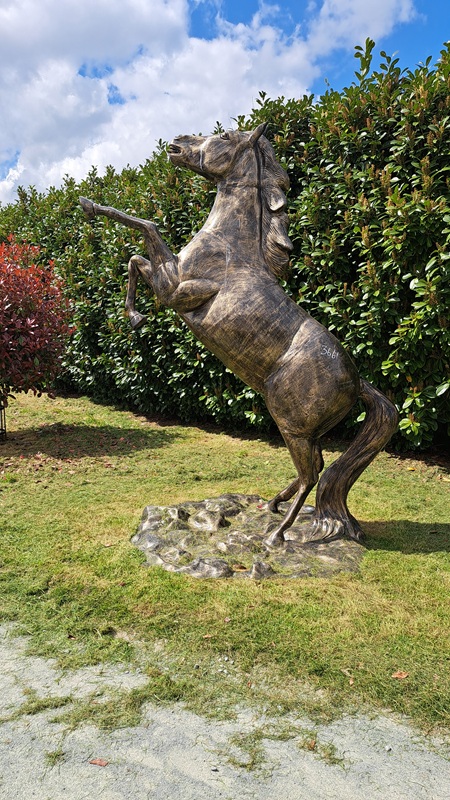
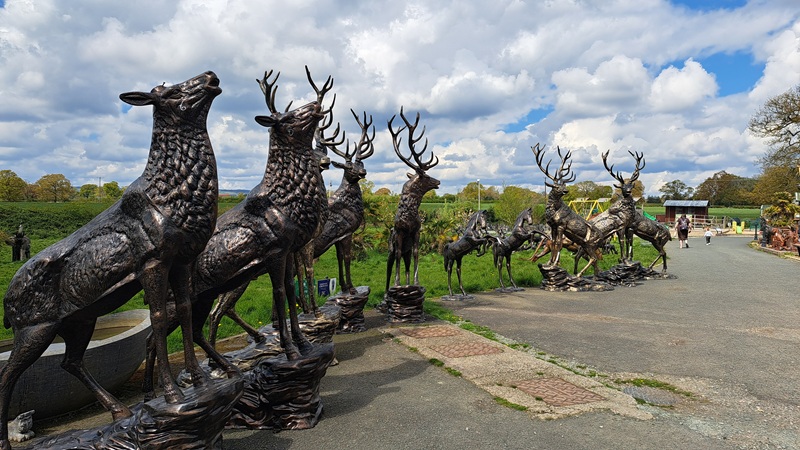
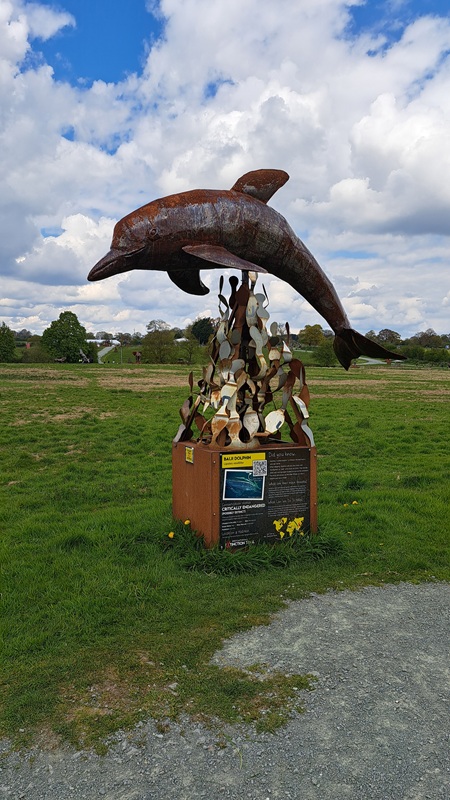
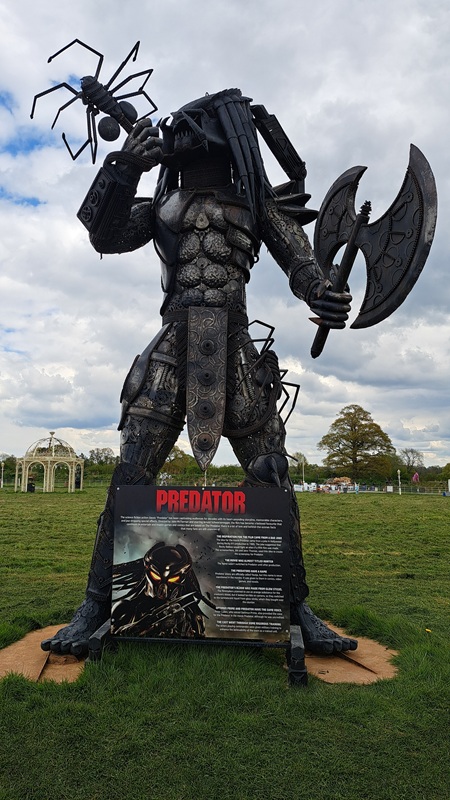
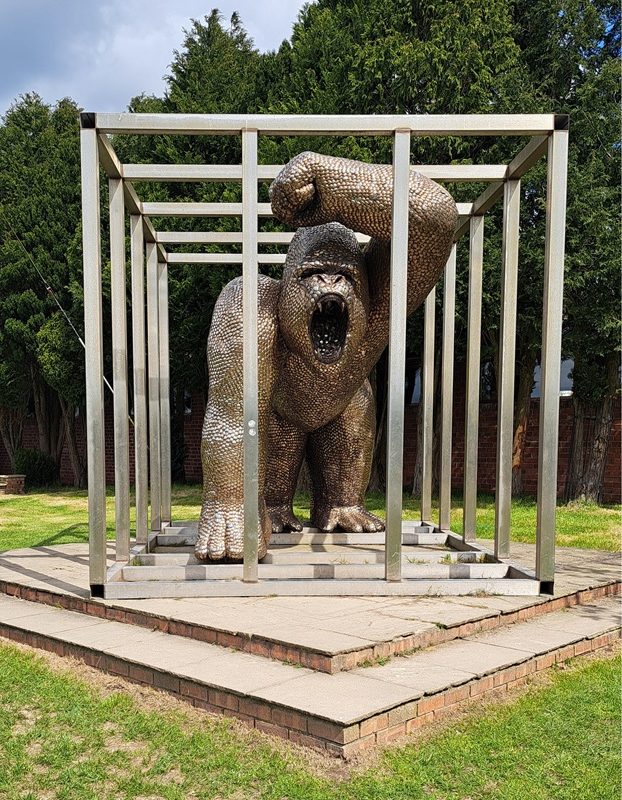
In the grounds, there are all sorts of sculptures.
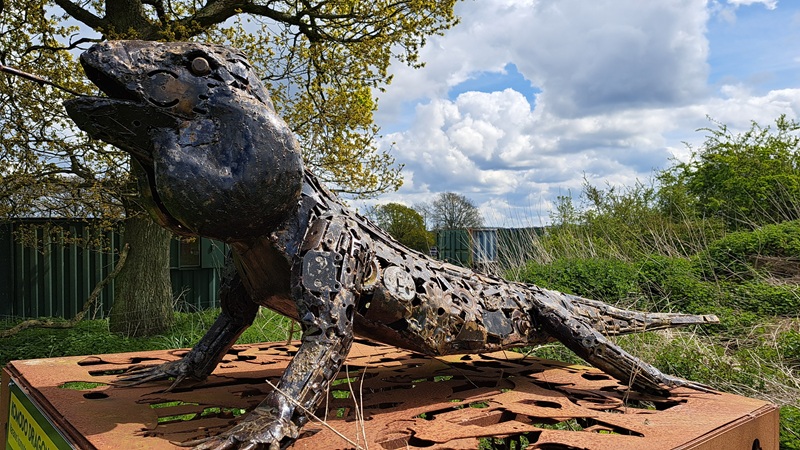
You can walk around the Extinction Trail which features endangered wildlife.
This close up photo of a Komodo Dragon sculpture shows the individual components of the whole piece.
There are some interesting figures as well as mythological and well-known pieces.
And ones that make you want to look closer.
All of the sculptures have more information about the individual pieces, but better yet, go and see for yourself! I thoroughly recommend it.
The Ananta Samakhom Throne Hall is a striking example of European design located in Dusit Park in Bangkok. It was commissioned by King Rama V in 1906 and built by royal architects Mario Tamagno and Annibale Rigotti in the Neo-Classical style.
Ananta Samakhom Throne Hall, Bangkok
This dome of the roof is typical of European structures at the time. Even the beautiful white marble was imported from Carrara in Italy.
I wrote about the wonderful Sagrada Familia last week, so this week, just take a moment to enjoy the beauty and serenity of arguably the best tourist attraction you will ever visit!
Unless you have witnessed the Sagrada Familia for yourself, I would bet that you have never seen anything quite like this before. I said this about Park Guell, but the Sagrada Familia in on another (Gaudi) level!
Antoni Gaudi was put in charge of designing this fabulous basilica in 1883 and it’s not finished yet! If you’d like to read the full history, there is an interesting timeline from the 19th century until the present day on the Sagrada Familia’s official website. One of the longest ever architectural commissions, but in Gaudi’s apparent words “My client is not in a hurry!”
My first glimpse of this impressive building as I walked down Carrer de Sardenya.
Before you even enter the basilica, your gaze will immediately be drawn to the wonderful sculptures on the walls – this being part of the Nativity Facade.
Inside, you won’t know where to look first. I was wide-eyed with wonder and excitement and my mouth spilled out a silent “wow!”
The stone columns throughout the interior have been designed in typical Gaudi style – to resemble a forest with its trees and branches reaching up into the vaults. It really is stunning!
With curved lines to mingle man-made structures with natural forms. This design can also be seen at Park Guell.
Once section of the basilica is also known as the temple of light because the beautifully coloured stain-glassed windows allows natural light to flood in at certain times of the day – creating an ethereal atmosphere.
A view along the nave and aisle.
If you include it in your ticket, you can ascend the stairs to the towers.
There are other, smaller features, that can be easily missed, like this emblem of Saint Luke.
And, as part of the stain-glassed designs, the names of places and people that might have some religious significance.
Outside, you can see the Passion Facade which is dedicated to the Passion of Christ with its pediment of bone-shaped columns at the top.
The 4 spires at the top of the Passion Facade represent 4 of the apostles – James, Thomas, Philip and Bartholomew. (Wikipedia)
The exterior of the basilica is carved with beautiful sculptures and features.
Other spires have bunches of fruit and wheat which represent the Holy Communion.
If you look upwards, you can see the construction work taking place at the top of the building. Once the final tower has been built, the basilica will become the tallest church-building in the world! (Wikipedia)
The Sagrada Familia is still a work-in-progress, but it is due to be completed around 2026 – some 143 years after Gaudi started his masterpiece.
It’s a beauty now and it will take your breath away, but just look at what it’s going to look like!
It’s a definite must-see attraction when you visit Barcelona.
As you enter Barcelona’s Gothic Quarter (Barri Gotic), you may wonder whether you will be able to find your way out. There are many narrow alleyways twisting this way and that, the only thing to do is just wander!
As you walk, make sure you look all around you and upwards in case you miss anything – the buildings are stunning and there is a mix of old and new everywhere.
Next to the Basílica de Santa Maria del Pi, on Placa de Sant Josep Oriol, a lively craft market was underway.
And here is the basílica in all her glory.
The Basilica of Santa Maria del Mar stands proud and has been since the 14th century.
People are making a beeline for the centre of the Gothic Quarter and pass the Chapel of Santa Agata on the way.
Arguably the main attraction is the Cathedral of Barcelona.
I don’t very often enter any of the buildings I seek out, but I know the inside of a cathedral is home to lots of paintings so, for once, I walked towards the door. I had chosen a day when there was a service going on, so no tourists were allowed in, but I made out I wasn’t one and the guy could see I was alone, so he let me in. Unfortunately, no photos were allowed, but trust me, the cathedral itself was stunningly beautiful and the paintings just added to its beauty.
Next, to Placa del Rei, a lovely medieval square. The steps are, allegedly, where Christopher Columbus met King Ferdinand and Queen Isabella after he came back from his first exploration.
Despite Barcelona being a busy city, there are still pockets that are less crowded.
And lovely little plazas to stop and rest a while.
I loved Barcelona and I loved exploring the Barri Gotic. I can’t wait to go back.
On a trip to Belgium in 2020, just two days into the new year, I went to Bruges for the day. It was a lovely way to spend a few hours. I loved it so much, I’m going to retrace my steps and hope that you will join me for a little tour around the city.
Bruges is just under an hour and a half from Brussels. Leave the station and walk up Oostmeers towards the city centre. There will be plenty of people doing the same, so you won’t get lost.
The narrow street is lined with houses including the almshouse of Reylof de Blieck – used as a shelter for the poor in the past.
At the end of Oostmeers, take a right onto Goezeputstraat and second-left onto Kleine Heilige-Geestraat. You’ll see the tall tower of Saint Salvador Cathedral on Sint-Salvadorskerkhof.
Walk around and you’ll see the whole cathedral.
From Sint-Salvadorskerkhof, go right onto Steenstraat and you’ll find yourself in the shopping zone with typical Belgian buildings converted into cute boutiques.
Keep going and you’ll come across the Markt – Bruges’ market square with its impressive buildings including the Belfry – arguably the most impressive.
The Provincial Hall isn’t bad either.
The market square is bustling with people and and there are also colourful old guild houses which have been converted into restaurants, so it’s also a good place to sit and eat and watch the world go by.
Just off of the Markt, you’ll find Eiermarket with some nice cafes and restaurants – stop for a coffee in Het Hof Van Rembrandt,
Venture onward and pass by Dumon Chocolatier, housed in this cute little building.
Go along Kuipersstraat, turn right onto Jakob Van Ooststraat, left onto Vlamingstraat and, finally, right onto Academiestraat and you’ll see The Burghers’ Lodge (Poortersloge) – a place where important citizens of Bruges held their meetings.
Head towards Augustijnenrei Canal and located by the Ezelsbrug or Donkey Bridge is thebeautiful Restaurant De Bottelier. I didn’t eat here, but I thought it was worthy of a photo.
Go back the way you came along Sint-Jakobsplein and St James Church stands on the corner.
Double back on yourself through the Markt, walk along Breidelstraat and you’ll come across Burg Square. In the far corner, you’ll see Blinde-Ezelstraat or Blind Donkey Street – a narrow alleyway running between Burg Square and Vismarkt. Apparently, there was an old inn called The Blind Donkey in the late 15th century.
Back on Burg Square, you’ll find part of the Brugse Vrije (Liberty of Bruges).
And the beautiful Gothic Stadhuis or town hall.
My walk took me further around the city centre but, for this tour, I wanted to show you some of the buildings in Bruges. I hope you enjoyed yourself. More of Bruges next time!
If you like architecture, Brussels has plenty of interesting buildings to see. But, it’s easy to miss some of the smaller details – all as stunning as the main counterpart!
See the decorative exterior windows of St Michael and St Gudula Cathedral – built in the Brabantine Gothic style.
Most people flock to see the Manneqin Pis – a statue of a small boy peeing. But, take in the stone niche in a rockery style surrounding the small statue – originally designed by Jerome Duquesnoy the Elder in the 17th century.
When I lived in Bangkok, I used to walk around the city with my camera a lot. There are many things that compel me to take a photograph. It could be a distinctive architectural feature, an ornate temple or a dilapidated building.
There are endless photographic subjects to be had in Bangkok and I had lots of fun looking for them! For me, it’s exciting because you never can tell what you might find!
Here are a few things that caught my eye!
This juxtaposition of 5-star hotel – Lebua – and the Leo beer advert.
The reflection of the buildings opposite the Eastin Grand Hotel in Sathorn.
The purple colour and zig-zag feature of the Mode Sathorn Hotel on Sathorn Road.
The colour and ornate decoration of Wat Bowonniwet on Phra Sumen Road.
Chong Nonsi Bridge for just being different and it’s good for a spot of people watching!
Chong Nonsi BTS Station under blues skies and white clouds with a glimpse of Bangkok’s infamous cables.
The high-rise Regis Hotel in Sathorn with its glass windows and reflections of the clouds.
I am not sure what this building is, but the brown bricks, arched windows and golden dome on the roof caught my eye. It was worth a close up!
More cables, people and a palm tree as the neon lights of the city flicker on at dusk!
There are many buildings like this in Bangkok where people have made their homes. It’s very humbling!
For more things that catch my eye around Bangkok, check out these posts
In Chiang Rai, I took a trip to the White Temple. I wasn’t sure how to get there because I was in the middle of nowhere and I hadn’t seen any people, let alone taxis. But, I needn’t have worried because the lovely Son, the owner of the homestay, called her driver to take me there.
I imagined the White Temple (Wat Rong Khun) to be located in a forest setting, far from any towns or cities, so I was surprised to find it was a long way from any forest. After driving for around 20 or 30 minutes, we came to a crossroads with rows of shops on either side and on the opposite side – the White Temple. Not exactly, how I imagined it. Still, it was one of the most beautiful temples I’d ever seen.
Wat Rong Khun was built by Chalermchai Kositpipat in 1997 as an offering to Buddha. He says, “Only death can stop my dream, but cannot stop my project. I believe the work will give me immortal life.” The construction work continues and it should be completed by 2070 – a lifetime’s work!
It’s very unique with a white exterior which represents spirituality rather than being focused on material things.
Every inch of the temple is covered in fragments of mirrored glass which make it dazzle in the sunlight.
On either side, there are reaching arms of those who were tempted by desires in life. The idea is that if you can cross the bridge (go through life) and forego these desires, you will achieve happiness.
At the other side of the bridge, you will come to the “Gate of Heaven” guarded by statues of Death and Rahu.
In front of the main temple, there are more interesting statues as well as other intricate architectural features.
You’re not allowed to take photos inside the temple, but the decor changes. Instead of images from Buddhist mythology, you are now faced with demons and images from the current era. Characters from famous films and modern-day idols like Michael Jackson. It’s all very strange and not something you see every day in a Thai temple.
In the temple grounds, there are other buildings.
All of the buildings in the complex are white apart from this golden one which houses the rest rooms. The gold colour symbolises the body.
There are other interesting things that may catch your eye.
It’s also a place for people to make merit and remember lost souls.
To make a wish.
To enjoy the nature.
Or to take a break in the shade.
If you are ever in Chiang Rai, go and experience the White Temple for yourselves. It really is a beauty!
I had a couple of more things on my itinerary. I took a taxi to town and had lunch right next to Chiang Rai’s clock tower – constructed by Chalermchai Kositpipat again!
My final destination was Wat Phra That Doi Chom Thong.
As this temple is at the highest point of the city, you’ll get lovely views from up there.
I got back to the homestay and had an another relaxing evening, my only company were the insects who had come out for the night. After my day exploring, it was soothing to listen to their sounds in the dark night. It made such a wonderful change, my usual night time sounds were the beeping horns on the busy Bangkok roads.